The Façade That Tells You When Something’s Wrong
How Digital Monitoring Is Replacing Guesswork in Façade Maintenance
Let’s be honest – for most of the industry’s history, façade inspection has meant one thing: someone on a rope or a cherry picker, looking at a wall, writing down what they see.
That approach isn’t wrong, exactly. It’s just incomplete. A visual inspection tells you what’s failed already. It can’t tell you what’s about to fail, what’s moving behind a panel you can’t see, or how a joint is performing under conditions it hasn’t faced yet. And on tall or complex buildings, it’s slow, expensive, and only ever a snapshot – a picture of the façade’s condition on one specific day, not an ongoing record of how it’s actually behaving.
That’s starting to change. Drones, embedded sensors, thermal imaging, and digital twin models are turning façade inspection from a periodic event into something closer to continuous monitoring. It’s not science fiction, and it’s not just for landmark buildings anymore. Let’s talk through what’s actually happening, what it costs, and where it genuinely helps.
Let’s Be Honest About How Façades Are Inspected Today
Most façade inspection regimes still run on fixed cycles – every one, five, or ten years, depending on building type, height, and local requirements. Someone accesses the building (rope access, MEWP, or scaffold), does a visual survey, flags anything obviously wrong, and files a report.
The problems with this are fairly obvious once you say them out loud. Access is expensive and disruptive, so inspections happen as infrequently as regulations allow rather than as often as would actually be useful. Visual inspection can’t see behind cladding panels, can’t detect early-stage moisture ingress before it shows externally, and relies entirely on the inspector catching a problem at the exact moment it’s visible. A crack that opens and closes with thermal movement might simply not be there on inspection day.
None of this makes traditional inspection worthless – it’s still necessary. But it’s a periodic sample of a building’s condition, not a continuous picture. And for buildings where façade failure has real safety consequences, a periodic sample is starting to look like it isn’t enough.
What Does “Digital Monitoring” Actually Mean?
In practice, it’s a combination of a few distinct technologies, usually deployed together rather than in isolation:
👉 Drone-based photogrammetry – high-resolution aerial surveys that capture the entire envelope, not just accessible sections, and build a detailed visual and dimensional record.
👉 Embedded sensors – small devices fixed to or behind the façade that continuously measure movement, moisture, temperature, and structural strain.
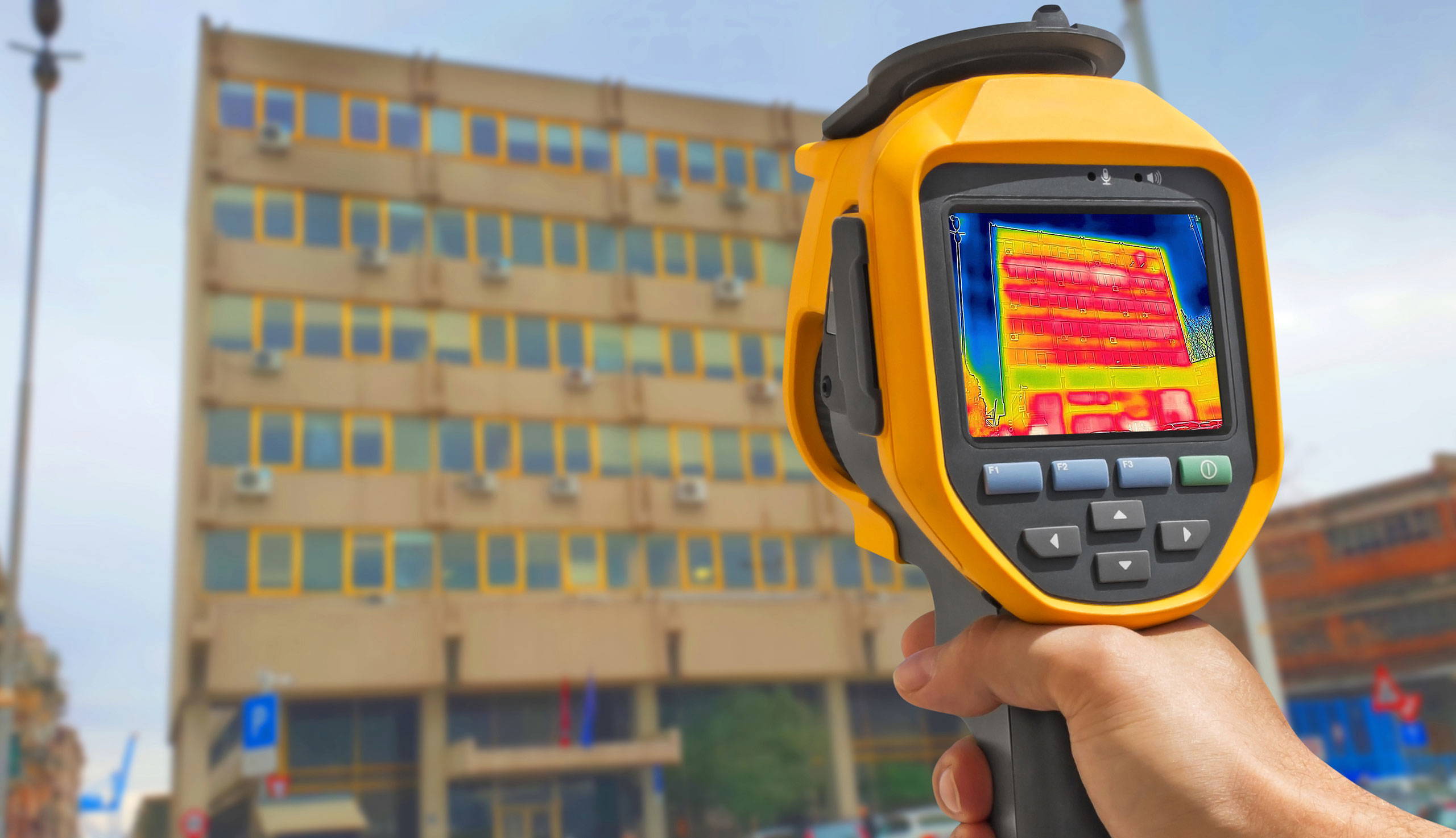
👉 Thermal imaging – identifies insulation gaps, water ingress, and thermal bridging that aren’t visible to the naked eye.
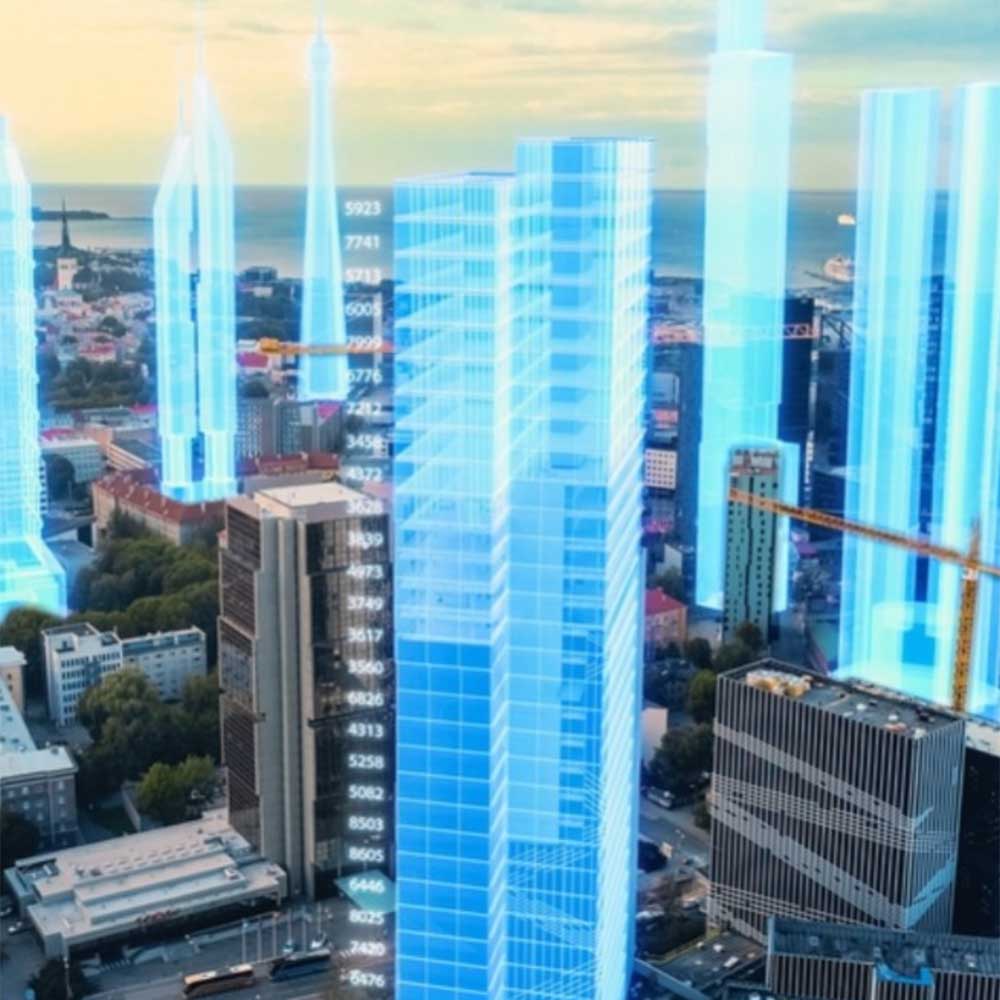
👉 Digital twin modelling – a live digital model of the building envelope that updates as new inspection and sensor data comes in, so condition data lives in one place instead of scattered across PDF reports.
None of these replace a qualified surveyor’s judgement. What they do is give that surveyor far more data to judge from, collected far more often than a rope-access visit ever could be.
Drones: The Obvious Starting Point
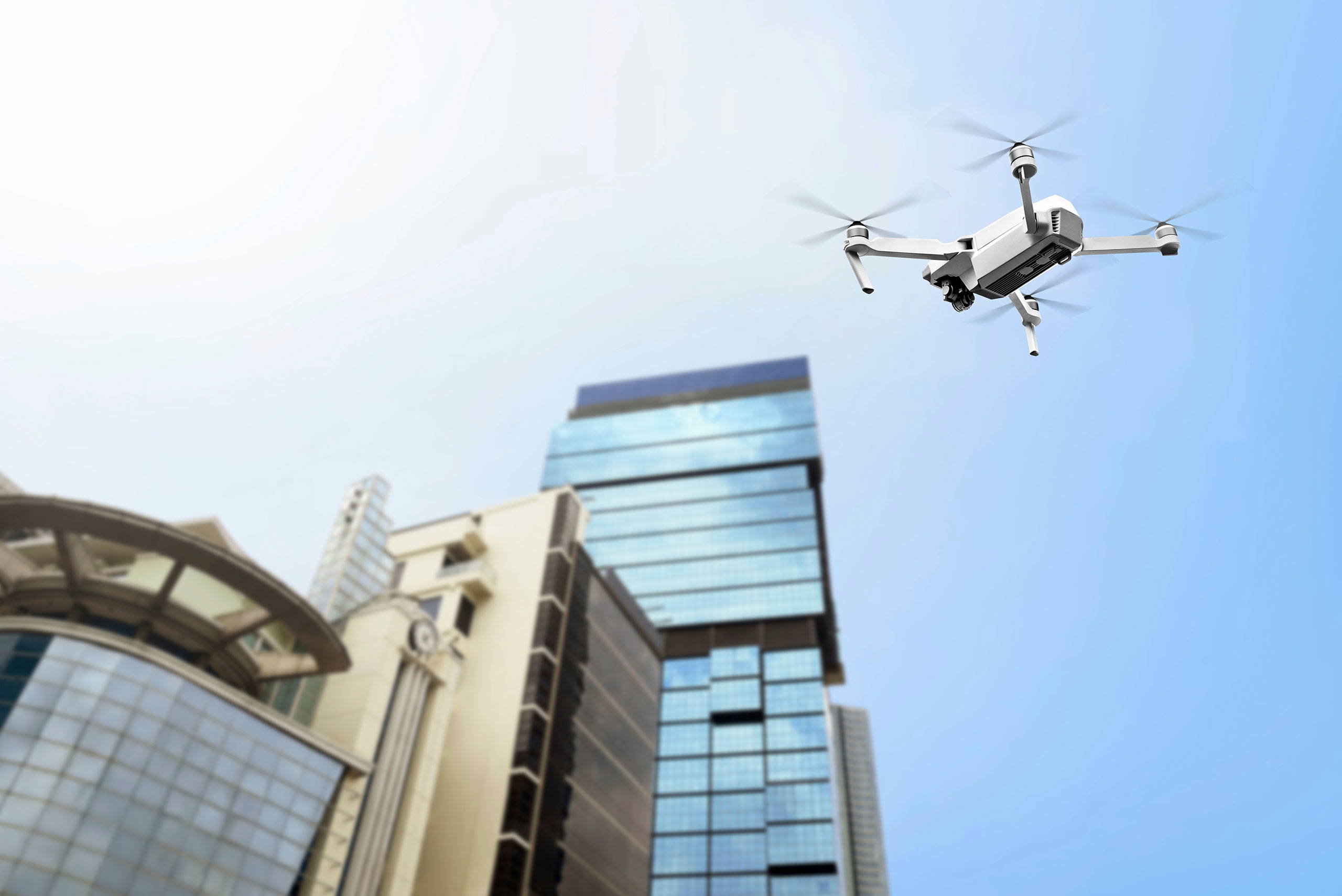
Drone surveying is the easiest entry point, and it’s also the one we use most often on live projects. A drone with a high-resolution camera can cover an entire tower façade in a fraction of the time and cost of rope access, capturing images detailed enough to spot hairline cracking, sealant degradation, and panel movement.
The real value isn’t just speed – it’s coverage. Rope access inspectors typically survey representative sections and extrapolate. A drone survey can capture every elevation in full, which means defects on sections that wouldn’t normally be prioritised for access actually get seen. We’ve picked up early-stage issues this way that a sampled inspection would very likely have missed for another inspection cycle.
It’s also considerably safer. No one needs to be suspended forty storeys up to get a clear look at a spandrel panel.
Sensors: The Quiet Revolution
Sensors are where this genuinely stops being “inspection” and starts being “monitoring.” Instead of checking a joint’s condition once every few years, a strain gauge or moisture sensor embedded at that joint reports continuously. If movement exceeds expected tolerances, or moisture appears where it shouldn’t, that gets flagged in near real time – not discovered eighteen months later when someone happens to be looking in the right place.
This matters most at known risk points: movement joints, high-exposure elevations, junctions between different cladding systems, and anywhere a building has a documented history of issues. You’re not sensoring the whole building – that would be neither necessary nor cost-effective. You’re targeting the 10–15% of the envelope where problems are statistically most likely to start, and watching it properly.
The trade-off is upfront cost and the need for a monitoring system someone actually reviews. A sensor network nobody’s watching doesn’t help anyone.
Digital Twins: Buzzword or Genuinely Useful?
“Digital twin” gets thrown around loosely enough that it’s fair to be sceptical. Stripped of the marketing language, a façade digital twin is simply a 3D model of the building envelope that’s linked to real inspection and sensor data, updated over time, so condition history lives in one place rather than across years of disconnected PDF reports.
The genuine usefulness shows up at handover points – when a facilities team changes, when a building is sold, or when a new consultant is brought in years later. Instead of reconstructing a maintenance history from a filing cabinet of old surveys, everything is in one model, dated and traceable. That traceability is also exactly what the Golden Thread of information requirement under the Building Safety Act is asking for on higher-risk buildings – a digital twin isn’t a compliance product, but it makes that documentation obligation considerably less painful.
Where it’s less useful: smaller, simpler buildings with straightforward façades and a good existing maintenance record. You don’t need a digital twin for a building that’s never had a problem and isn’t likely to. Scale the tool to the risk.
Is It Worth The Investment?
This is the question every building owner actually asks, so let’s answer it directly. Drone surveys typically cost less than rope access for equivalent coverage, so that one pays for itself immediately in most cases. Sensor networks and digital twin modelling are a genuine upfront cost that needs to be weighed against what you’re protecting against.
For higher-risk buildings – tall residential, buildings with a known history of façade issues, or anything falling under Building Safety Regulator oversight – the case is straightforward: early detection of a moisture or movement issue costs a fraction of what remediation costs once it’s progressed to visible failure. For simpler, lower-risk buildings, a periodic drone survey combined with traditional inspection at key intervals is often the right level of investment, without the ongoing cost of a full sensor network.
The mistake we see most often isn’t under-investing – it’s applying the same monitoring approach to every building regardless of risk profile. That’s expensive on the low end and inadequate on the high end.
What This Means For Building Owners And Facilities Managers
Practically, this shifts façade maintenance from a reactive, cyclical task to something closer to ongoing condition management. Instead of budgeting for “the five-year inspection,” owners start budgeting for continuous data collection with periodic expert review – which tends to catch problems earlier and spreads maintenance spend more predictably over time, rather than facing large, unplanned remediation costs when something is finally discovered.
It also changes the conversation with insurers and buyers. A building with a documented, continuous condition history is a materially easier sell – and a materially easier building to insure – than one with a folder of periodic reports and gaps in between.
Where Is This Heading?
Drone surveying has already moved from novelty to standard practice on anything above low-rise. Sensor-based monitoring is following the same path on higher-risk buildings, driven as much by regulation as by technology cost coming down. Digital twins are the piece still maturing – genuinely useful today for complex or high-risk buildings, and likely to become standard practice more broadly as the tools get cheaper and the Building Safety Act’s documentation requirements push more owners toward structured digital records by default.
The direction of travel is clear either way: façade condition data is moving from “something we check periodically” to “something we know continuously.” That’s a better position for everyone involved – owners, occupants, and anyone who has to sign off that a building is safe.
Let’s Answer Some of the Most Common Questions
Do I need sensors on my whole building, or just parts of it?
Just parts of it, in almost every case. Target known risk points – movement joints, high-exposure elevations, areas with a history of issues – rather than sensoring the entire envelope.
How much does a drone façade survey typically cost compared to rope access?
Drone surveys are generally cheaper than rope access for equivalent coverage, and they’re faster, with less disruption to occupants and no need for access equipment on site.
Can drones replace rope access inspection entirely?
Not entirely – drones are excellent for visual and thermal coverage, but some close-up or hands-on assessments (testing sealant condition physically, for example) still need direct access.
What’s the difference between a digital twin and just having digital survey reports?
Digital survey reports are static snapshots. A digital twin is a living model that’s updated as new data comes in, giving you a continuous condition history rather than a series of disconnected documents.
Is digital monitoring only relevant for tall or high-risk buildings?
It’s most valuable there, but drone surveys and targeted sensors can be cost-effective on mid-rise buildings too, especially ones with a known maintenance history or complex cladding systems.
Does this help with Building Safety Act compliance?
It helps considerably with the Golden Thread of information requirement, since it creates a traceable, dated record of the façade’s condition and any interventions – but it’s a tool that supports compliance, not a substitute for it.
How often should sensor data actually be reviewed?
Continuously for alerts that exceed set thresholds, with a full expert review on a regular schedule – typically quarterly or annually depending on risk level. A sensor network is only useful if someone’s actually reviewing what it reports.
What happens if a sensor flags a problem – what’s the process?
It triggers a targeted investigation at that specific location, usually starting with a closer visual or thermal check before deciding whether physical access or remedial work is needed. It’s about narrowing down where to look, not an automatic alarm.
Is this technology proven, or still experimental?
Drone surveying and thermal imaging are well established at this point. Sensor-based structural health monitoring and digital twins are newer but increasingly common on complex and higher-risk projects, not experimental in any meaningful sense.
Final Thought
The building envelope has always been trying to tell you something – it’s just that, historically, we’ve only been listening once every few years. Digital monitoring doesn’t replace expert judgement, and it isn’t the right level of investment for every building. But for the buildings where it matters, it turns façade maintenance from a guessing game into something you can actually see coming.
If you’re weighing up whether digital monitoring makes sense for your building, get in touch – we can talk through what level of coverage actually fits your risk profile before you spend on anything.