
Engineering Solutions
Material Selection and Engineering Solutions
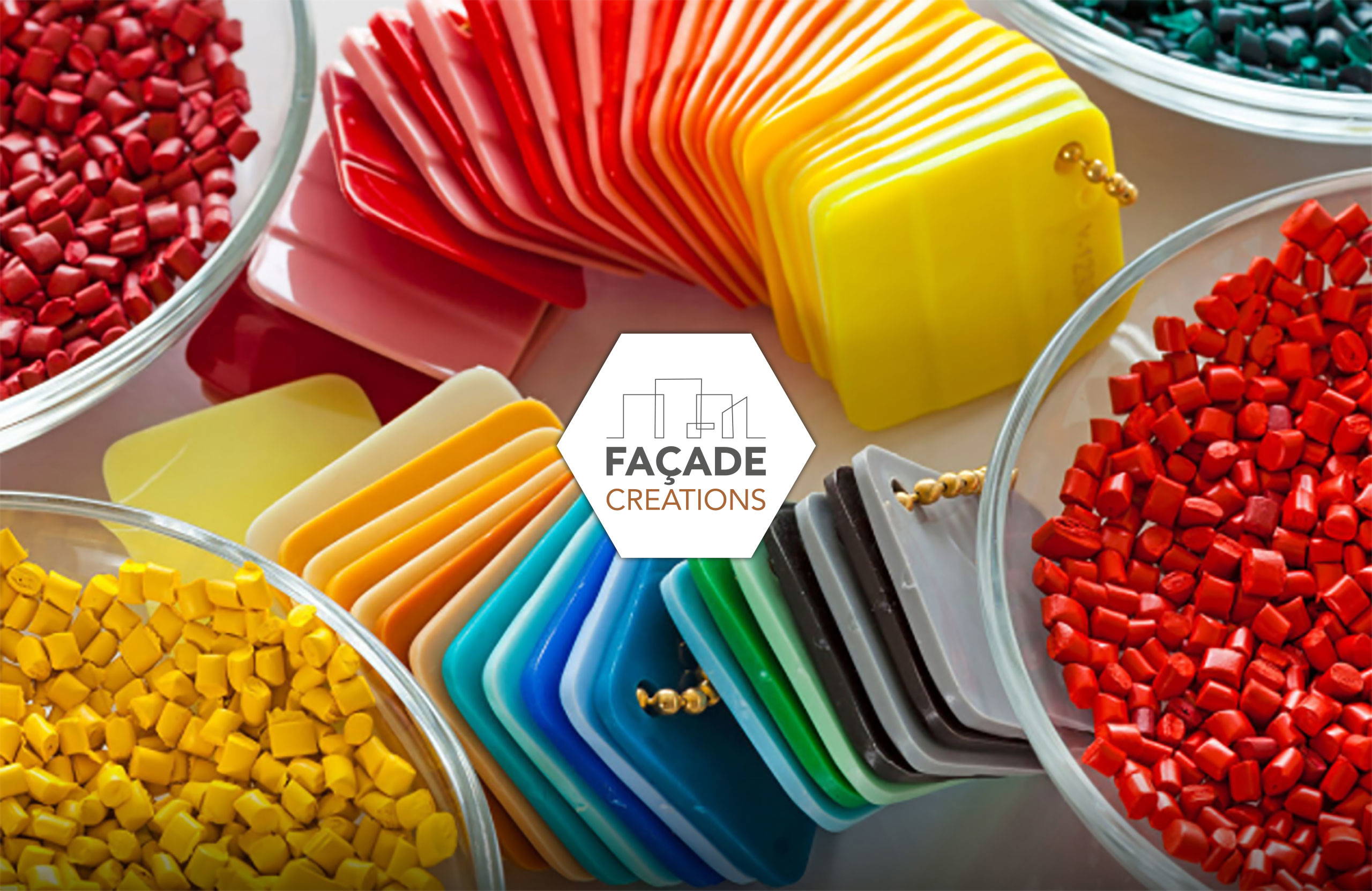
High-performance and engineering plastics are used in every sector of industry. Only with the right material can a design achieve its desired functionality, safety, and service life – so the plastic material selection process is critical to successful part design. It is primarily the application conditions that determine the right choice of material. However, in addition to the application conditions, the search for a suitable plastic should also take a number of other considerations into account.
Comparison and Selection of Plastics
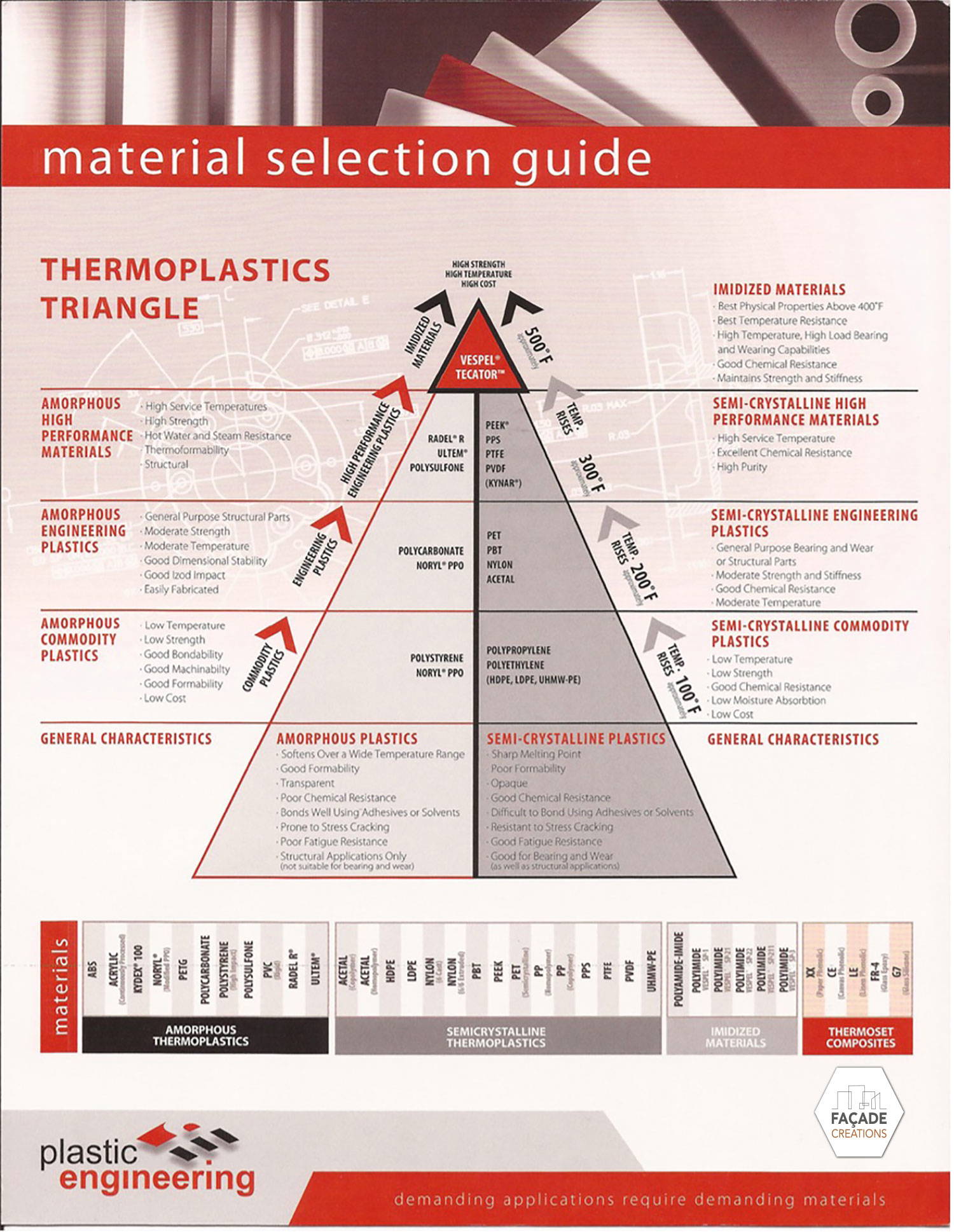
In attempting to determine a suitable material for a particular application, it is important to compare the plastic properties, material characteristics, and the requirement profile in detail. Façade Creations supports the material selection process with an advisor tool and plastic selection guide, providing all the data available on our stock shapes in an organised way. Our plastics material selector helps you find the right polymer to suit your requirements: browse the full range of plastics available, or use the filter options to narrow the choice down to plastics consistent with your selected attributes. Please note, the material selector should only be used as a guide and should not replace practical testing.
With the plastic material selector, it is possible to limit the choice of suitable materials to a manageable number. Our comparison tool allows users to compare the details and properties of up to four different plastic materials at a time on a single page. To activate the tool, click on the comparison button, available in the product overview (material selector) or on each product page.
Selection of Properties
The term chemical resistance is generally used to describe the resistance of a material to the effects of chemicals.
Material selection criteria and properties can be complex. The following section explains the main product characteristics and test methods, as well as providing a compact outline of our extensive collection of plastics-related knowledge – in addition to theoretical facts and information on requirements, it also recommends available materials.
Electrical requirements
Most engineering thermoplastics are inherently electrically insulating. However, when an application does have electrical requirements, the key issue is often whether the material exhibits electrically dissipative or conductive characteristics.
For example, when producing electronic components, dissipating or conductive materials are often chosen to avoid static charges that could harm electrical circuits. This also applies to ATEX applications (ATmosphere EXplosive), where the objective is to reduce the likelihood of catastrophic explosion due to electrostatic discharge.
Mechanical stress
To assess the suitability of a material in terms of its exposure to mechanical stress levels, it is desirable to obtain as much detailed information about the suspected levels of stress as possible. In most cases, it is very helpful to obtain a print of the component with information relating to the mechanical stress.
Thermal stress
Thermal stress is another key criterion restricting the selection of material. Therefore, the temperatures transferred to the materials as a result of the application conditions must be taken into account. In addition to the possibility of heat being transferred from the outside, system-related heat created by factors such as friction must also be taken into consideration. Characteristics closely related to changes in temperature include:
Chemical stress
If a component is likely to come into contact with chemicals, the material’s resistance to the substances in question should also be considered in light of the application conditions. Critical factors include contact temperature, contact time and concentration. Not only should the chemical substances to be encountered in the application be considered, but also those which will be used during part manufacture and processing (such as machining lubricants).
Tribological stress
Tribological considerations are those made necessary in applications that will expose the part to wear caused by high loads, friction, or sliding actions. In these cases, good sliding properties and abrasion characteristics are required.
Radiation / weather resistance
If components are used, for instance, for outdoor applications, in radiology, or in applications involving exposure to high-energy radiation such as power stations, the materials used require suitable radiation resistance. Decisive to the material selection are the exposure dosage and the relevant application conditions.
Fields of Application / Sectors of Industry
Sometimes the industry in which the part is to be used places limits on the material selection process. This could be due to government agency approvals, or customer-specific specifications that indicate only certain types of materials, meeting certain specific criteria, can be used.
Aerospace
In industries such as Aerospace and Semiconductor, where vacuum is of importance, materials with high ionic purity are required.
When it comes to applications used for fire protection, e.g. in aerospace, flame-retardant materials are required.
Biopharma & Medical Technology
In the medical and biopharma technology sectors, often only materials that come with approvals for direct bodily contact are acceptable.
As a high proportion of medical products have to be sterilised for reuse, resistance against common sterilisation methods is required.
Medical applications are often involved in surgery and need to be image-controlled within the process. To achieve visibility of components under fluoroscopy and X-ray radiation, special materials have to be used.
Food Technology
In the field of food technology, by contrast, approvals in compliance with U.S. FDA regulations, as well as European standards (e.g. 10/2011/EC, 1935/2004/EC), are required. Consequently, for these industries only materials that comply with the requirements of these regulations can be considered.
The demand for detectable materials is increasing as a means to keep unwanted particulate matter from entering the food processing chain. Broken plastic fragments can be quickly traced as part of the standardised process control system, thanks to special additives used in these specially modified materials.
Mechanical Engineering
The areas of application for plastics in mechanical engineering could not be more diverse. Materials for these areas have to fulfil a variety of requirements, for example:
- Good sliding and wear properties
- Corrosion resistance
- Temperature resistance
Oil & Gas
The environment for applications in the field of oil and gas is highly demanding. Compliant materials according to NORSOK M-710, Edition 3, are therefore required.
Semiconductor & Electronics
In semiconductor manufacturing equipment, even the smallest trace amounts of foreign molecules can cause contamination and compromise yield. Consequently, materials must provide high ionic purity and low outgassing.
For sensitive components requiring electrostatic discharge (ESD) control, Façade Creations offers conductive and anti-static materials.
Further Processing
How the material is processed plays a decisive role in choosing the material. The material selector therefore offers a selection of the form in which the plastic can be acquired: as semi-finished rod, plate or tube, compound, filament or composite. To complement our products, we offer a comprehensive range of processing methods, as well as customised profiles and tubes, to meet your individual requirements for your finished part.
Machining is the predominant method used for further processing of plastic semi-finished products. In order to produce high-quality, durable, precisely dimensioned and flawless components, as much attention must be paid to the tools and processing parameters as to the characteristics of the specific materials, e.g. their mechanical properties.
In many cases, thermoplastics can be very successfully joined to themselves or to other materials by means of welding and bonding.
Technical Advice
To help with the material selection process, our application engineering advisors are also happy to help. Not only will you get support on selecting the right material, but also on further processing, regulations and requirements. Our broad, application-specific expertise enables us to assist you from the very first product idea, through the selection of materials and designs, to the finished component. For all this and any additional enquiries, please do not hesitate to contact our advisory team for free expert advice at any time.
Get in touch with our Solutions & Services team
(However, if you prefer to speak to someone directly? Call our aerospace team or email us and we’ll respond promptly.)
Team Contact Form